
REVISION

Revision Techniques and Environment
Year 11 Revision
Revising is the process of revisiting content that you have previously studied in order to strengthen, extend and improve your knowledge and understanding of a subject.
It helps you to remember facts, figures, topics and methods that you may have covered some time ago.
Revision is not just about remembering information. It also helps you to:
- Build confidence in what you know.
- Identify gaps in your understanding.
- Improve your ability to apply knowledge to different questions.
- Feel more prepared for assessments and exams.
When done effectively and consistently, revision can increase your confidence, improve your understanding and reduce feelings of anxiety before exams.
The pyramid below is structured to help you revise effectively. Follow each stage to help you plan, organise and structure your revision in the best way possible.
Choose a Subject
Use your Year 11 Preparation booklet or your most recent interim report to help you choose a starting point. It might be a subject you find difficult or a subject where you are furthest behind your target grade.
Use Resources
You will have access to numerous resources:
- Exercise books/booklets
- Textbooks
- Knowledge organisers
- Online revision platforms
- Revision guides
- This booklet!
It is important that you use these resources to ensure you are revising the correct content and at the appropriate level of detail.
Your Year 11 Preparation Booklet was designed to support your planning and make each subject more manageable.
Once you know what you need to revise, you should summarise the information into key points that you can remember and recall during an exam.
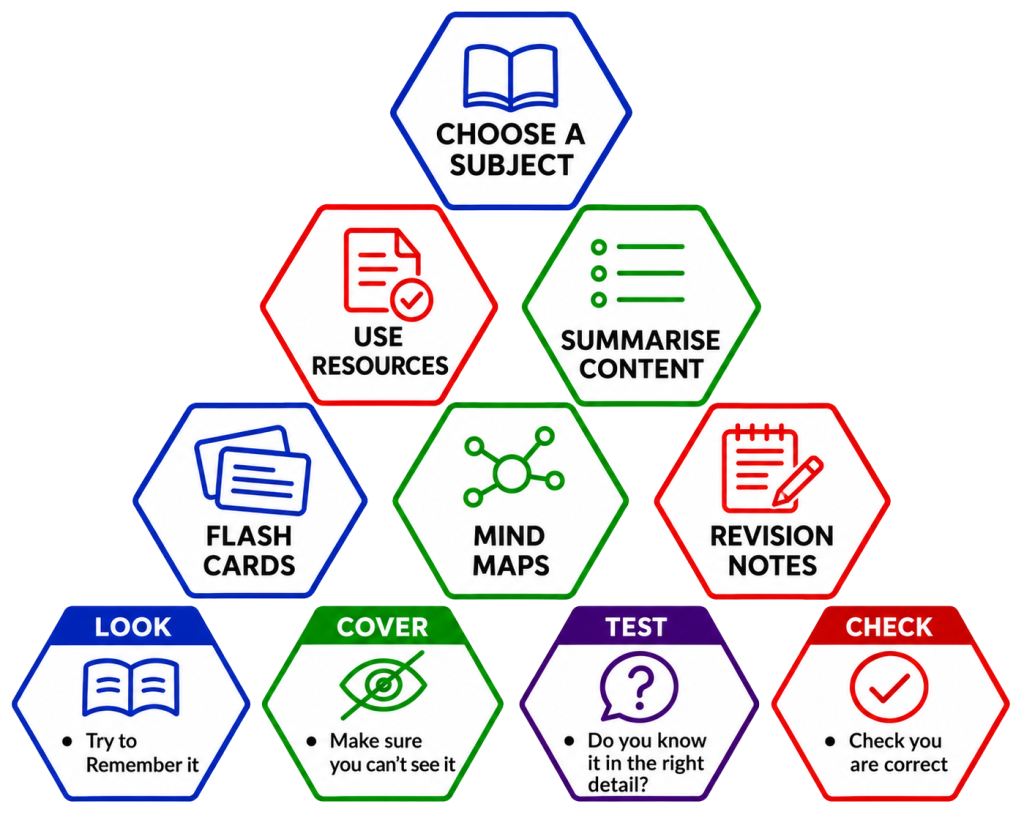
Summarise Content
Here is a quick guide on how to summarise:
Read and identify the essentials
- What are the main concepts?
- What smaller concepts link to these main ideas?
- What definitions do you need to know?
- Write them accurately so you can recall them precisely in an exam.
- What processes or steps do you need to remember?
- Are there any patterns, sequences or mnemonics that could help?
- What examples help explain the topic?
- Are there any structures, models or case studies you could use?
- What formulae, dates, facts or quotations do you need to know?
- Which of these require exact recall?
There are three main methods of creating revision resources that we recommend:
Flash Cards
Write the topic title on one side of a small card (approximately A6 size) and the key summarised information on the other.
Flash cards are great for breaking information into manageable chunks. They can be highly effective for memorisation, as they allow you to regularly test your knowledge and recall important information.
Mind Maps
Organise your summarised information into a diagram that shows how ideas connect to one another. Start with the main topic in the centre and branch out into subtopics and finer details.
Mind maps are an excellent visual revision tool, helping you understand connections between concepts and identify the level of detail needed for each area of study.
Revision Notes
Record your summarised information as structured notes in a notebook or revision folder. Use clear headings and subheadings to organise information logically and make it easier to review.
This technique is particularly effective for students who prefer information to be organised, detailed and kept in one place for easy reference.
Once you have created a resource, you need to use it. Use ‘Look, Cover, Test and Check’ to help you learn information.
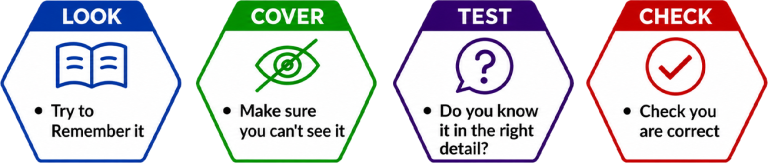
Look
Actively read your work and try to pick out the key pieces of information that you will need to remember. At this point, repetition is really useful – go over it 3–4 times.
Cover
Try to challenge yourself by avoiding the temptation to peek at your notes. The more accurately you test yourself, the more effective your revision will be.
Test
Try to recall the information in the correct level of detail. Really work hard at this stage and, again, be honest with yourself.
Check
Look back at your work to make sure you have the answers right and in the appropriate level of detail. Did you get it completely right? If you did, move on. If you didn’t, go back to the start.
Regular practice using these techniques will help build your confidence and ensure you are ready to demonstrate your knowledge when it matters most.
Need Support?
Don’t forget, there are lots of revision sessions happening around school after school – please make the most of the opportunity to attend.
For more details, have a look at the information screens around school and in the downstairs restaurant at breaktime!
Struggling to find your year 11 preparation booklet?
All of the relevant pages from the year 11 preparation booklet can be found here.